
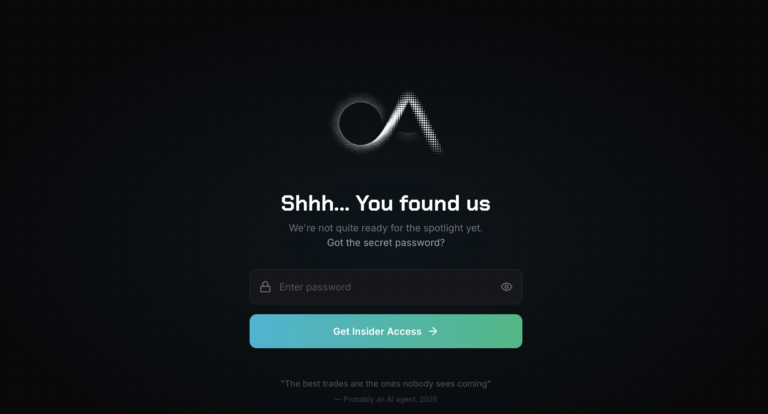
There is a particular kind of investment story that can be difficult to evaluate from the outside. It does not necessarily begin with an obviously suspicious website. Instead, it begins with a person who appears to understand markets. They talk about quantitative trading. They mention algorithms. They discuss data, models and financial markets. They may describe themselves as running a quant fund or working with sophisticated trading technology. To someone who has spent years hearing about hedge funds, systematic strategies and algorithmic trading, the language can sound credible. That is what makes the allegations surrounding OnlyAlpha AI worth examining carefully.
OnlyAlpha.ai has been named in recent consumer complaints involving alleged investment losses. One February 2026 BBB Scam Tracker report identifies OnlyAlpha.ai in an investment complaint and alleges that the operation used multiple names, including Seaquake and OnlyAlpha.ai. A separate ScamPulse report concerning Seaquake and OnlyAlpha.ai reports a claimed loss of $34,084.54. One report supplied to Brokers Litmus makes an additional and particularly serious allegation.
The complainant says that a person identified as Dylan presented himself as operating a quantitative fund and allegedly used that representation to obtain money and intellectual property. That allegation requires careful handling. There is a difference between documenting what an individual reports and declaring that the underlying accusation has been legally proven. This review therefore looks at the available information, the nature of the quant fund claims, the public complaints and the questions an investor should ask before placing money or proprietary material with a platform presenting itself in this way.
What is OnlyAlpha AI?
OnlyAlpha.ai is the website associated with the name OnlyAlpha AI in the reports reviewed for this investigation. At the time of researching this review, independent search results did not provide the kind of extensive institutional footprint that would ordinarily make it easy to establish a long operating history, regulated fund structure or independently verified investment record.
That does not prove that a company is illegitimate. It does mean the burden of verification becomes more important. A sophisticated investment operation should be more than a name, a website and a person making claims about quantitative finance. If someone says they operate a fund, investors should be able to establish what legal entity operates it, what jurisdiction it operates from, who controls it, what assets it manages and what independent records exist to support its claims. Those questions become even more important when money and intellectual property are involved.
The quant fund claim deserves a closer look
“Quant” has become a powerful word in modern investing. Quantitative investment firms use mathematical and statistical techniques to analyze markets and make investment decisions. The field is real. So are algorithmic trading, systematic strategies, machine learning models and automated execution. Academic research has increasingly examined how machine learning is being incorporated into quantitative investment, including applications involving prediction, portfolio construction and trading execution. But the existence of legitimate quantitative finance does not mean that calling something a quant fund proves anything about its legitimacy.
That distinction is crucial. Anyone can describe a strategy as quantitative. The meaningful questions are what data it uses, what model generates its signals, how trades are executed, where customer assets are held, how performance is independently verified and which legal entity is responsible for the activity. A label is not evidence.
What does a real quant operation have to explain?
There is no single formula that every quantitative fund follows. Different strategies use different markets, time horizons and models. One firm may trade equities. Another may focus on futures. Another may trade currencies. Another may specialize in statistical arbitrage. Some strategies operate at extremely high frequencies, while others may hold positions for days or months. But regardless of strategy, a serious operation should be able to explain its investment framework at an appropriate level.
That does not mean revealing proprietary code. A fund does not need to publish its secret sauce for an investor to conduct basic due diligence. It should still be possible to establish who operates the fund and how the investment arrangement works. There should also be a distinction between a strategy being proprietary and the entire operation being unverifiable. Those are not the same thing.
AI does not automatically make an investment strategy sophisticated
The same problem exists with artificial intelligence. AI is now used throughout financial research. Machine learning can help process large datasets, identify relationships, classify information and generate predictive signals. But saying that a system uses AI tells an investor almost nothing about whether the system works. A model can be technically impressive and still lose money.
A backtest can look extraordinary and still fail in live trading. A model can identify patterns that disappear when market conditions change. And a strategy can produce attractive historical results because of overfitting rather than genuine predictive power. This is why serious quantitative research places so much emphasis on validation. The interesting question is not simply, “Does this use AI?” It is:
What evidence shows that the strategy continues to work outside the environment in which it was developed?
The difference between a backtest and real performance
This is one of the most important distinctions investors should understand. A backtest asks what a strategy would have done using historical data. Live trading asks what actually happened when real money was exposed to the market. Those are not interchangeable. A historical model can look spectacular and then perform poorly when deployed.
The reasons can include transaction costs, slippage, liquidity constraints, changing market regimes and model overfitting. A sophisticated investment presentation may therefore contain charts showing years of simulated performance. Those charts can be interesting. They are not the same thing as independently verified live returns. For an alleged quant fund, the difference is fundamental.
Why independently verified performance matters
Suppose someone claims that an algorithm produced exceptional returns. There are several ways an investor might encounter that claim. The person could show a spreadsheet. They could provide screenshots. They could display a chart on a website. They could show an account dashboard. They could provide a backtest. Or there could be an independently verifiable record of actual trading performance.
Those forms of evidence are not equal. A screenshot can be edited. A spreadsheet can be constructed. A backtest can depend heavily on assumptions. A dashboard can display information that the investor cannot independently verify. That is why institutional investors place significant importance on records, custodians, administrators, auditors and other forms of independent verification.
The intellectual property allegation changes the picture
The report supplied to Brokers Litmus contains an allegation that Dylan presented himself as a quant fund operator and used that representation not only to obtain money but also to obtain intellectual property. This is a materially different allegation from a straightforward investment complaint. Money and intellectual property are separate categories of exposure. An investor can potentially lose money through a failed investment.
Intellectual property can involve source code, trading models, research, algorithms, datasets, business methods, documentation or other proprietary material. Once proprietary material leaves its owner’s control, the problem may not be limited to a financial loss. That is why anyone dealing with an alleged quantitative fund should distinguish between an investment relationship and a technology or research relationship. If somebody wants access to your proprietary work, that deserves its own documentation.
A quant strategy can be valuable even before it makes money
This point is often overlooked. Suppose an investor or developer has spent years building a trading model. The model may contain no publicly traded asset itself. It may simply identify relationships in market data.
Nevertheless, the underlying research can have significant commercial value. The same applies to source code, proprietary datasets, execution logic and research notebooks. That is why intellectual property protection matters when dealing with anyone claiming to operate a quantitative investment business. An investor should know exactly what information they are sharing, why it is required and what contractual restrictions govern its use.
Never confuse an investment pitch with a technology agreement
If somebody wants money to invest, that is one relationship. If somebody wants your code, algorithms or research, that is another. If they want both, the distinction becomes even more important. A properly documented arrangement should make clear what is being provided.
Who owns the intellectual property?
Is the material being licensed or transferred?
Can the recipient modify it?
Can it be used for another business?
Can it be shared with contractors?
What happens if the relationship ends?
What happens to copies?
These questions are not accusations. They are basic questions about ownership. A legitimate quantitative research relationship should have no reason to object to clarity around intellectual property rights.
The Seaquake connection deserves attention
One of the strongest pieces of independent information located during this research is the connection between OnlyAlpha.ai and the name Seaquake in consumer reports.
A February 2026 BBB Scam Tracker complaint explicitly alleges that the subject operated the scheme across multiple brand names, including Seaquake and OnlyAlpha.ai. The complaint also alleges that the total losses may have been substantially higher than the complainant’s own reported loss. The BBB page records $9,500 in losses for that particular report.
Separately, ScamPulse has a February 27, 2026 report titled “Seaquake and OnlyAlpha.ai.” That report records a claimed investment loss of $34,084.54 and identifies OnlyAlpha.ai as the associated website. These reports are consumer allegations. They should not be treated as court findings. But the appearance of the same names across independent complaint databases is relevant due diligence information. It warrants asking whether the brands are connected, who controls them and whether the same individuals or infrastructure appear behind them.
Why multiple brand names matter
Businesses can have multiple brands. There is nothing inherently wrong with that. A legitimate company might own several products or operate several websites. The problem arises when the relationship between those brands is unclear. An investor should be able to determine whether two apparently separate businesses share ownership, management, personnel, technology or financial infrastructure.
If they do, that information can materially change how an investor evaluates the opportunity. In the case of OnlyAlpha.ai, the existence of consumer reports linking the name with Seaquake means this is an area that deserves additional scrutiny rather than assumption.
The importance of corporate identity
One of the most basic questions in financial due diligence is surprisingly easy to overlook. Who exactly are you dealing with? A brand name is not necessarily a legal entity. A website is not necessarily a company. A person describing themselves as a fund manager is not necessarily the legal operator of an investment fund.
Before transferring money, an investor should identify the actual legal entity involved. That includes its jurisdiction, registration status, responsible individuals and regulatory position where applicable. If those details cannot be established independently, the investor is being asked to place substantial trust in a name rather than a verifiable business structure.
What does the money actually buy?
This question should be answered before an investor sends funds. Does the investor purchase shares in a fund? Does the money go into a managed brokerage account? Does the investor receive an interest in a partnership? Does the investor lend money to a company?
Does the investor simply transfer money to an account controlled by someone else? These arrangements have very different legal and financial characteristics. The phrase “quant fund” does not answer the question. Neither does “AI trading.” The investor needs to understand the actual structure.
Where are the assets held?
This may be one of the most important questions of all. If someone says they manage investments for you, ask where your assets are actually held.
Are they in an account in your name?
Are they held by an independent custodian?
Are they at a regulated brokerage?
Are they transferred to a company-controlled wallet?
Are they pooled with other investors?
The answers matter because custody determines who actually controls the assets. A trading strategy can be legitimate while the custody arrangement is poor. Conversely, an impressive custody arrangement does not prove that the strategy is good. The two questions must be examined separately.
What happens to proprietary information?
The intellectual property allegation makes this question particularly relevant. Before sending source code, trading logic, datasets or research to anyone, an investor or developer should understand exactly what happens after the material is received. A confidentiality agreement can define obligations around sensitive information.
An intellectual property agreement can define ownership and permitted use. A license can define what the recipient is allowed to do. None of these documents guarantees that a dispute will never happen. They do, however, create a much clearer record than sending proprietary work through informal conversations.
A serious fund should survive basic questions
Sophisticated investors ask uncomfortable questions. They want to know who the manager is. They want to understand the strategy. They want to know where assets are held. They want to understand fees. They want to see appropriate performance information. They want to understand risks.
They want to know the withdrawal or redemption process. They want to know who audits or administers the fund where applicable. None of this is unreasonable. In fact, the more sophisticated the claimed investment operation, the more reasonable these questions become. A person should not be able to invoke “quantitative finance” as a reason to avoid basic verification.
Why secrecy is not the same as sophistication
There is a temptation to assume that a truly advanced trading strategy must be secret. That is only partly true. The exact model can remain confidential. The business structure should not have to. A fund can protect proprietary research while still providing investors with meaningful information about the legal entity, custody arrangements, risk controls, fees, valuation procedures and reporting. A secret algorithm and a secret company are two very different things. Investors should not confuse them.
The modern AI problem
Artificial intelligence has made this distinction even more important. A few years ago, someone claiming to operate an advanced investment algorithm might have sounded unusual. Today, the phrase “AI powered trading” appears everywhere. That creates an information problem. The technology itself is no longer sufficient evidence. An investor needs to understand what the AI actually does.
Does it generate research ideas?
Does it predict prices?
Does it determine portfolio weights?
Does it execute trades?
Does it simply summarize financial information?
Is a human making the final decisions?
These are completely different systems. The word AI tells you none of that.
A useful test for any claimed quant fund
Ask the person to explain the investment process from beginning to end.
Where does the data come from?
How is it cleaned?
What does the model predict?
How is a signal converted into a position?
How is position size determined?
How are transaction costs handled?
How is risk controlled?
How are trades executed?
Where are assets held?
How is performance calculated?
How is performance independently verified?
A legitimate quantitative professional may not reveal proprietary formulas. But they should understand these questions. If someone cannot explain the structure of their own investment operation without falling back on vague references to AI, proprietary technology or secret algorithms, that should cause investors to slow down.
The complaints should not be treated as isolated anecdotes
Consumer reports are imperfect. They can contain misunderstandings. They can contain incomplete information. They do not automatically establish criminal conduct. But patterns can still matter. In this case, there are at least two independently published complaint records connecting OnlyAlpha.ai with investment losses, and one of them specifically connects OnlyAlpha.ai with the name Seaquake. That does not prove every allegation. It does provide enough information for a prospective investor to perform deeper due diligence before transferring money or proprietary material.
What investors should document
Anyone who has already interacted with OnlyAlpha.ai should preserve the original records. That includes emails, messages, agreements, invoices, payment records, wallet addresses, transaction hashes, screenshots, presentations and copies of any documents that were provided.
If intellectual property was shared, preserve the original files and their creation dates. Keep evidence showing when the files were created and when they were transferred. Do not rely solely on a conversation history that may later become unavailable. A chronological record can become extremely important if a financial or intellectual property dispute develops.
What the available evidence does not establish
It is equally important to be precise about what this investigation cannot establish. The available consumer reports do not by themselves prove that Dylan committed fraud. They do not establish the full ownership structure of OnlyAlpha.ai. They do not establish the total number of affected people.
They do not prove that every interaction associated with the website was fraudulent. And the allegation that intellectual property was taken has not been independently established by the sources located for this review. Those limitations should remain visible. Good investigative reporting is not stronger because it exaggerates. It is stronger because readers can see exactly which facts are verified and which claims remain allegations.
Our assessment of OnlyAlpha AI
The available information gives prospective investors several reasons to proceed with extreme caution.
First, there are recent public complaints identifying OnlyAlpha.ai in connection with alleged investment losses.
Second, the BBB complaint specifically alleges that the operation used more than one brand name, including Seaquake and OnlyAlpha.ai. That claim should be independently verified rather than accepted automatically, but it is significant enough to investigate.
Third, the report supplied to Brokers Litmus alleges that an individual presented himself as a quantitative fund operator while obtaining both money and intellectual property.
Fourth, the “quant fund” label itself should not be accepted as proof of sophistication. Genuine quantitative investment operations can be evaluated through their legal structure, custody arrangements, reporting, risk controls and independently verifiable performance.
Finally, the combination of financial allegations and an intellectual property allegation makes this more than a simple question about whether an investment strategy performed well.
It raises questions about identity, ownership, custody, documentation and the handling of proprietary information.
Final verdict
Our view is that prospective investors should not send money or proprietary trading material to OnlyAlpha.ai without independently establishing the identity, legal structure and regulatory status of the entity they are dealing with. The available evidence is not sufficient for us to state as a fact that every allegation against OnlyAlpha.ai or the individuals associated with it has been proven. It is sufficient, however, to justify serious due diligence. The public record includes a BBB Scam Tracker complaint identifying OnlyAlpha.ai in an investment dispute and alleging connections with another name, Seaquake. A separate ScamPulse report also names Seaquake and OnlyAlpha.ai and records a claimed loss of $34,084.54.
The complaint supplied to Brokers Litmus adds another dimension by alleging that a person presenting himself as a quant fund operator obtained money and intellectual property. That last point should be independently investigated rather than repeated as an established fact. For investors, the practical lesson is straightforward. Do not let the words “quant,” “AI,” “algorithmic,” or “fund” do the due diligence for you. Find the legal entity. Verify the people behind it. Establish where the assets are held. Understand exactly how the investment works.
Ask how performance is independently verified. Understand what happens to your money after you send it. And if someone wants access to proprietary code, research or intellectual property, treat that as a separate commercial transaction requiring clear ownership and confidentiality terms. Sophisticated language can describe a sophisticated business. It can also create the appearance of sophistication. The only reliable way to tell the difference is to look underneath the language.