
Cryptocurrency investigations can become complicated very quickly when the name of a legitimate company appears in a complaint. That is exactly why this ViaBTC review requires a little more care than simply looking at one report and deciding that the company is responsible for everything described in it. A report submitted to Brokers Litmus describes an investor who says they lost more than $120,000 after putting substantial money into a cryptocurrency investment opportunity. The person says they also encouraged several colleagues to participate before realizing that something was wrong. The report eventually says the investor recovered the money and recommends a third party called CypherForensics as a way for other victims to recover cryptocurrency. There is a problem with treating that account as evidence against ViaBTC itself. The information available from ViaBTC’s official website describes a very different business model.
ViaBTC says it was founded in May 2016 and operates as a blockchain services provider centered around cryptocurrency mining. The company says it serves more than one million users across more than 150 countries and regions. That distinction matters. A company being mentioned in a cryptocurrency complaint does not necessarily mean the company caused the loss. Sometimes criminals impersonate legitimate businesses. Sometimes victims are directed to lookalike websites. Sometimes a legitimate service is used somewhere in a much larger transaction. And sometimes the name of a real company is simply included in a story without enough evidence to establish what actually happened. This is why the question in this case should not simply be, “Is ViaBTC legitimate?” It should be:
Was the person actually dealing with ViaBTC.com?
What Is ViaBTC?
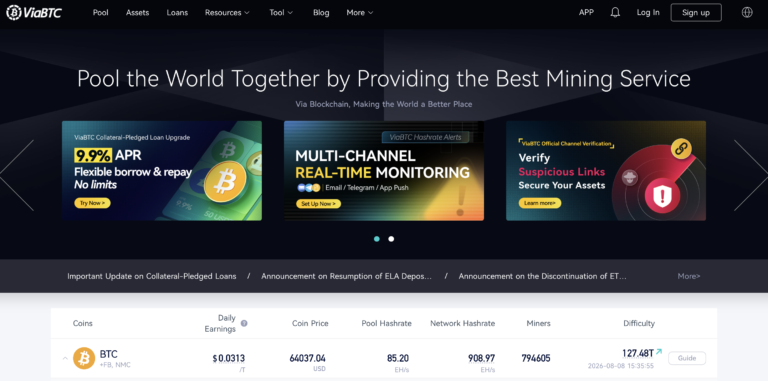
ViaBTC is a cryptocurrency mining pool and blockchain services company. According to its official company information, ViaBTC was founded in May 2016. The company says its services include cryptocurrency mining pools and related blockchain products, and it describes itself as serving users globally. Its current website offers mining services for several cryptocurrencies and provides tools for monitoring mining activity, managing assets and calculating mining profitability.
This is important because ViaBTC should not simply be described as an online investment broker. Its core business is mining infrastructure. That is materially different from a company that approaches consumers with a conventional investment portfolio and promises to manage their money for them.
What Does ViaBTC Actually Offer?
The company’s website describes a range of mining related services. These include mining pools, mining management tools, asset management functions and other cryptocurrency related services. ViaBTC also provides different payout structures for miners, including PPS+ and PPLNS. PPS+ pays miners according to valid submitted shares and is designed to provide more predictable payouts.
PPLNS works differently. Rewards depend on the miner’s contribution relative to the pool’s total hashrate over a specified number of difficulty rounds when a block is found. This is not the same thing as handing money to an investment manager and receiving a guaranteed return. That distinction should be clear to anyone researching the company.
The Submitted Report Raises a Different Question
The report received by Brokers Litmus describes an investment exceeding $120,000. The investor says they were attracted by promises of high returns and eventually persuaded colleagues to participate as well. They describe the experience as devastating and say they ultimately recovered the money. That account deserves to be documented. But there is not enough information in the report to establish that the actual company operating at ViaBTC.com received the money. There are no wallet addresses supplied in the report.
There are no transaction hashes. There are no screenshots showing the ViaBTC domain. There are no payment instructions identifying a ViaBTC corporate account. There is no contract establishing ViaBTC as the investment counterparty. Without those details, connecting the alleged $120,000 loss directly to ViaBTC would go beyond the evidence available to us. That is not a minor distinction. It is the difference between documenting a complaint and making an unsupported allegation.
Why the Exact Website Matters
Cryptocurrency users should become accustomed to checking the exact spelling of a website. This is especially important when a company has a recognizable brand. The legitimate ViaBTC website is viabtc.com. A similar looking domain can be something completely different. A single character can separate a genuine website from an impersonation site. The same problem can occur with mobile applications, social media accounts, Telegram channels, customer support accounts and email addresses.
A person may say: “We are ViaBTC.” That statement should never be accepted simply because the name looks familiar. Verify the domain. Verify the account. Verify the communication channel. Verify where the money is being sent.
A Familiar Name Can Create False Confidence
This is one of the most interesting aspects of cryptocurrency fraud. A criminal does not always need to invent a completely unknown company. Using the identity of an existing business can be much more effective. If a victim recognizes the name, they may be less suspicious of the opportunity.
That is why brand impersonation deserves separate attention from conventional investment fraud. The existence of a legitimate company does not mean every person using its name is legitimate. This is particularly relevant when the communication begins outside the company’s official website. An unsolicited Telegram message claiming to represent a cryptocurrency company should not be trusted simply because the company itself exists.
Check the Domain Before Sending Anything
The first practical step is surprisingly simple. Look at the address bar. Do not rely on the logo. Do not rely on the page design. Do not rely on a search result. Check the actual domain. If someone sends you a link, compare it character by character with the company’s official website.
If they claim to represent ViaBTC, independently type the official address into your browser rather than using a link provided by the person contacting you. This reduces the possibility of following a lookalike website.
The Official ViaBTC Website Tells a Different Story
ViaBTC’s own description of its services is useful when evaluating the submitted report. The company says its services are primarily designed for mining related purposes and explains that users are responsible for understanding the risks associated with digital currency mining. Its terms specifically state that the services provided through its system are mining related and that users are responsible for equipment, internet access, electricity and other mining costs.
That is very different from the kind of arrangement described in the report. The submitted complaint describes a substantial investment promoted on the basis of high returns. ViaBTC’s published terms describe mining services and associated risks. Those two descriptions should not automatically be treated as the same thing.
Mining Is Not the Same as a Guaranteed Investment
This distinction is worth understanding. Mining involves contributing computing resources to a blockchain network. A mining pool combines the work of many miners and distributes rewards according to the pool’s payout structure. Returns can be affected by cryptocurrency prices, network difficulty, hashrate, electricity costs, hardware performance, fees and other variables.
ViaBTC’s own terms explicitly warn that cryptocurrency prices can fluctuate significantly and potentially fall to zero. That language is important. It means anyone presenting ViaBTC as a way to generate guaranteed high returns would be making a claim that needs to be examined separately from what the company itself publishes.
The Difference Between Mining Revenue and Investment Returns
A common source of confusion in cryptocurrency is the word “profit.” A mining pool may display estimated mining revenue. That does not mean a user has been promised an investment return. Mining revenue is connected to computational work and blockchain rewards. Investment returns are generally discussed in terms of capital appreciation, interest, portfolio performance or other financial outcomes. Those are different concepts. An investor should understand exactly what they are purchasing.
Are they buying mining capacity?
Are they operating their own equipment?
Are they joining a mining pool?
Are they depositing funds into a trading account?
Are they lending cryptocurrency?
Are they buying an investment product?
If the person explaining the opportunity cannot clearly answer that question, stop before sending money.
What About the $120,000 Loss?
The figure in the submitted report is significant. The investor says potential losses exceeded $120,000 before the funds were eventually recovered. But the report does not provide enough evidence to establish that ViaBTC itself received or controlled those funds. That means the amount should be treated as the reported loss associated with the investor’s experience, not as a verified ViaBTC customer loss.
This distinction is important for readers. It prevents an unverified complaint from becoming a misleading statement about a real company. It also gives the victim something more useful than an unsupported accusation. It gives them a framework for determining what actually happened.
Follow the Cryptocurrency Transaction
If someone believes their cryptocurrency was sent to a fraudulent platform, the blockchain can provide evidence that ordinary bank transactions sometimes cannot. A cryptocurrency transaction generally creates a transaction hash that can be examined on the relevant blockchain. The wallet address involved can also be recorded. That creates an important investigative trail. Instead of relying entirely on screenshots, an investigator can ask:
Which wallet received the cryptocurrency?
When was it received?
What asset was transferred?
How much was transferred?
Where did the funds go afterward?
Were the assets moved to another address?
Was the destination associated with a known exchange?
Was the transaction actually sent to a ViaBTC controlled address?
These questions are much more useful than simply seeing the word “ViaBTC” in a conversation.
Transaction Evidence Matters More Than a Screenshot
A screenshot can be edited. A website can be copied. A Telegram username can be changed. An email address can be created. A blockchain transaction is different. A transaction hash can potentially provide a permanent record of the movement of cryptocurrency on a public blockchain. That does not automatically identify the person behind a wallet. But it provides something investigators can work with. Anyone investigating a cryptocurrency loss should preserve transaction hashes, wallet addresses, dates, amounts and the network used. Do not delete them. They may become important later.
Be Careful With Cryptocurrency Recovery Services
This is especially important because cryptocurrency victims can become targets for a second round of fraud. The Federal Trade Commission warns about refund and recovery scams in which someone contacts a person who has already lost money and promises to recover the funds for a fee. The FTC specifically advises consumers not to pay upfront for recovery assistance and warns that requests for money or sensitive financial information can be a sign of another scam. Recovering cryptocurrency is not impossible. But no legitimate investigator can honestly guarantee that lost cryptocurrency will be recovered simply because you pay an upfront fee.
The Second Loss Can Be Worse Than the First
This is something every victim should understand. After losing a large amount of money, people naturally want answers. They want someone to tell them:
“We know where your money went.”
“We can recover it.”
“We have identified the wallet.”
“We just need a processing fee.”
That promise can be extremely persuasive.
It can also create another financial loss. The FTC advises consumers to be particularly cautious when someone approaches them unexpectedly and claims they can recover money lost to fraud. The safest approach is to verify the recovery organization independently before paying anything.
What ViaBTC’s Terms Say About Risk
ViaBTC’s terms are unusually useful for understanding what the company itself says about its services. The company states that users should have sufficient knowledge and experience with digital currency mining and understand the associated risks. It also states that cryptocurrency prices can fluctuate significantly and may potentially fall to zero.
ViaBTC also says that information provided through its website should not be treated as personalized professional investment advice. That is important context for anyone evaluating claims made by third parties using the ViaBTC name. If somebody tells you that ViaBTC guarantees a particular return, that claim should be independently verified.
How ViaBTC Makes Money
Understanding the business model is another useful part of due diligence. ViaBTC publishes fee information for its mining pool. It says PPS+ carries a relatively higher fee because the pool assumes certain risks associated with pool luck and orphaned blocks. PPLNS operates differently and charges a smaller operational fee, with payouts depending on block discovery and the miner’s share of the pool’s relevant hashrate. That structure is consistent with a mining pool business model. It is very different from the simple promise of: “Deposit money and receive high returns.” If someone presents the latter as what ViaBTC is offering, the investor should investigate the claim carefully.
There Is a Difference Between ViaBTC and Someone Using the ViaBTC Name
This may ultimately be the most important point in this entire review. A criminal can say they represent a legitimate company. A fake website can copy a legitimate company’s branding. A social media account can use a legitimate company’s name. A Telegram account can claim to be customer support. A person can even provide genuine information about the company to make the impersonation more convincing.
None of those things establishes that the communication actually came from the company. This is why brand impersonation cases can be difficult to investigate. The victim may genuinely recognize the company. The company itself may genuinely exist. The fraud may still have nothing to do with the actual company.
What Should Someone Do If They Sent Money?
Start by preserving everything. Keep the original messages. Save screenshots. Save emails. Save website addresses. Record usernames. Save cryptocurrency wallet addresses. Record transaction hashes. Write down dates and amounts. Keep copies of payment records. Do not delete conversations because they are embarrassing. Do not assume that an account disappearing means the evidence has disappeared. The earlier the evidence is organized, the easier it becomes to reconstruct what happened.
What Makes the Submitted Report Difficult to Verify?
There are several major evidence gaps in the report. The exact ViaBTC account is not identified. The precise website used is not documented beyond the ViaBTC name. No transaction hashes are supplied. No wallet addresses are provided. No payment records are included. No screenshots are available for independent examination. No correspondence demonstrating that ViaBTC employees made the investment promises is provided. That does not mean the reported experience did not happen. It means there is insufficient evidence to attribute it to the actual ViaBTC.com operation. That is an important distinction.
Our Assessment of ViaBTC
Based on the evidence reviewed for this article, we do not have sufficient evidence to label the legitimate ViaBTC.com website a fraudulent investment platform. The available company information describes ViaBTC as a long-running cryptocurrency mining and blockchain services provider founded in 2016. It says the company serves more than one million users in more than 150 countries and regions. Its official website describes mining pools, mining management, asset management and related cryptocurrency services. Its terms describe mining-related services and explicitly disclose the risks associated with cryptocurrency and mining.
The submitted report, meanwhile, describes a high-value investment opportunity and a loss exceeding $120,000, but it does not provide enough evidence to establish that the actual ViaBTC.com business was the recipient of those funds. That means the appropriate conclusion is caution, not accusation. If the person who submitted the report has transaction hashes, wallet addresses, screenshots or correspondence showing that the real ViaBTC organization solicited the investment, those materials could materially change the assessment.
Final Verdict
The strongest conclusion from this investigation is not that ViaBTC is a scam. It is that the ViaBTC name should not be trusted simply because someone uses it during a cryptocurrency investment pitch. The legitimate company has a documented presence dating back to 2016 and describes itself primarily as a cryptocurrency mining and blockchain services provider. Its published terms describe mining-related services and warn users about the substantial risks associated with digital currencies. The $120,000 loss described in the submitted report is serious, but the evidence supplied does not establish that the legitimate ViaBTC.com company caused or received that loss. That leaves an important possibility that should be investigated carefully: someone may have been using a legitimate cryptocurrency company’s name to create credibility around an unrelated investment operation.
If you have been approached by someone claiming to represent ViaBTC, verify the exact website and communication channel before sending anything. If cryptocurrency has already been transferred, preserve the transaction hashes and wallet addresses. If someone later promises to recover your money for an upfront payment, investigate them just as carefully. And if you are unsure whether the person who contacted you was actually affiliated with ViaBTC, do not rely on their own explanation. Go directly to the official website and verify the relationship independently. In cryptocurrency, the name on the screen is not enough. The domain matters. The wallet matters. The transaction matters. The legal entity matters. And ultimately, the evidence matters more than the story.