
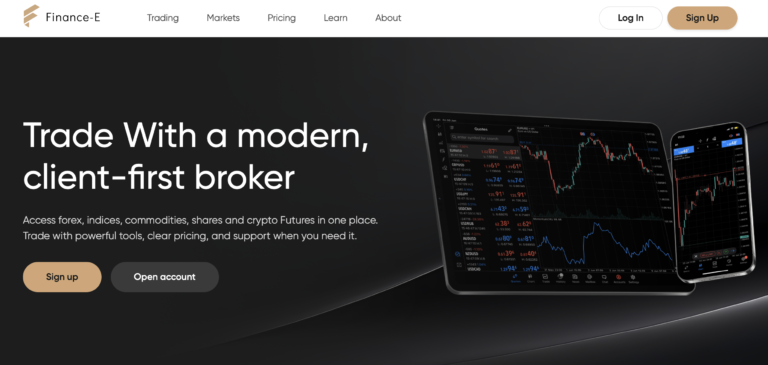
An investment advertisement does not need to look suspicious to attract attention. In fact, the most effective financial promotions often do the opposite. They look modern. They use familiar technology. They talk about artificial intelligence, automated trading, financial markets, and sophisticated algorithms. The presentation can make an investment opportunity feel less like a gamble and more like a piece of financial technology that has already figured out the difficult part. That is the context in which Finance-e deserves a closer look. Finance-e operates through finance-e.com and presents itself as a trading platform covering areas including forex, indices, commodities, shares, and cryptocurrency futures. Independent website analysis also identifies the domain as a relatively new registration, with a creation date of October 23, 2025.
A BBB Scam Tracker report submitted on April 14, 2026 describes a very different experience from the polished investment story a prospective customer might expect. The complainant reported discovering Finance-e through a sponsored Facebook advertisement promoting AI trading and claimed daily gains of approximately 1 percent. The report says the customer was assigned a trainer, deposited money, saw what they believed were investment gains, and later encountered a series of explanations when attempting to withdraw. The reported loss was $25,000. A complaint is not the same as a regulatory finding, and the account should be treated accordingly. But it raises questions worth investigating.
What is Finance-e?
Finance-e presents itself as an online trading platform offering access to multiple financial markets. Its website description identified by independent website analysis says the platform provides access to forex, indices, commodities, shares, and cryptocurrency futures, alongside trading tools and support. That broad range is worth examining because the more markets a platform claims to cover, the more important it becomes to understand exactly what customers are being offered.
Are investors purchasing actual assets? Are they trading derivatives? Is the platform acting as a broker? Is it providing software connected to another brokerage? Are customers depositing funds into an account controlled by the company? Those questions are more useful than simply asking whether the website looks professional. A financial website can present itself as sophisticated while leaving the underlying structure difficult for an ordinary investor to understand.
How the reported Finance-e experience began
According to the BBB complaint, the investor encountered Finance-e through a sponsored Facebook advertisement promoting AI trading. The advertisement reportedly promised gains of approximately 1 percent per day. That is an important detail because advertising is often the first layer of an online investment relationship. A person does not necessarily begin by searching for a particular financial company. They may encounter an advertisement while doing something completely unrelated. The advertisement creates curiosity. A landing page provides more information.
A representative makes contact. An account is opened. The investor then begins receiving guidance. At that point, the original advertisement may already be several steps removed from the actual financial relationship. That makes it important to preserve the original advertisement whenever possible. The wording used to attract an investor can be very different from the explanations provided after money has been deposited.
The appeal of artificial intelligence
Artificial intelligence has become one of the most powerful marketing terms in financial technology. That is understandable. AI is genuinely being used across finance for areas such as data analysis, fraud detection, forecasting, automation, portfolio management, and other applications. The problem is that the word itself does not tell an investor how a particular system works. A company can say that its software uses AI without explaining the model, the data, the strategy, the limitations, or the risks involved.
Investors therefore need to separate the technology claim from the investment claim. “AI is involved” does not answer the more important question. “How does this system actually generate the return being shown in my account?” That is the question Finance-e investors should be asking before relying on any advertised performance.
The mathematics behind a 1 percent daily return
The reported claim of approximately 1 percent gains per day deserves particular attention because daily returns compound rapidly. A 1 percent daily return does not simply mean 365 percent over a year. If an investment genuinely increased by 1 percent every day and the gains were compounded, $10,000 would grow to approximately $377,834 after 365 days. That is an extraordinary result. Real markets do not provide a smooth path of guaranteed daily gains, and legitimate investments can lose money.
This does not mean that a 1 percent daily performance claim automatically proves misconduct. It does mean investors should ask exactly what the figure represents. Is it a target? A hypothetical example? A historical best case? A gross return? A return before losses and fees? Or an actual independently verified performance figure? The difference is enormous.
A percentage is not evidence by itself
Investors often give performance numbers more authority than they deserve. A platform displays 1.2 percent. Then 2.1 percent. Then 4.7 percent. The numbers appear precise, and precision can create confidence. But a number is only useful when the investor can understand how it was produced.
A genuine trading result should have an underlying explanation. There should be positions, transactions, pricing, market exposure, and some method for calculating the result. If the investor cannot determine what produced the return, the percentage itself is not enough. This is one of the central questions surrounding any online trading platform. What exists behind the number?
The trainer model deserves attention
The BBB report describes the investor being assigned a trainer who helped with setup and taught them how to use the platform. Having customer support is not inherently unusual. Many legitimate brokers provide educational material, account managers, trading tutorials, or customer assistance. The issue is the role the individual plays. An educator should help a customer understand the platform.
A financial professional may provide regulated advice where authorized. But an investor should understand whether the person communicating with them is a salesperson, educator, account manager, broker, or representative of some other kind. The distinction matters because personal guidance can create a level of trust that the website itself may not establish.
Why the “app” matters
According to the complaint, the investor was instructed to download what was presented as an app for Finance-e. This is another area where investors should be careful. An application can make an investment relationship feel more established. Once an app is installed on a phone, the service becomes part of the user’s daily routine. The investor can open it in seconds and see the balance. That convenience is useful when the underlying service is legitimate. But the presence of an application does not independently verify the assets displayed inside it.
Investors should know where an application came from, who published it, what permissions it requests, and what company actually controls the account behind it. A financial app is a user interface. It is not, by itself, proof that the money displayed inside it exists in the form represented.
The most revealing moment may be the withdrawal request
Depositing money is easy to understand. The investor sends money. The account receives it. The balance changes. A withdrawal is different. The direction of the money reverses. Instead of asking the customer to put money into the platform, the customer is asking the platform to send money out. That makes withdrawals one of the most useful practical tests of an online investment relationship.
According to the BBB complaint, the reported difficulties began when the investor attempted to withdraw funds without informing the people assisting them. The complaint describes a series of explanations involving additional deposits, a frozen account, an administrator, taxes, and fees.
That sequence deserves attention. The important question is not simply whether a platform charges fees. Legitimate financial services charge fees. The important question is whether the requirements were clearly disclosed and whether the investor can independently verify why they are being imposed.
The moving target problem
There is a major difference between a withdrawal policy and a changing list of conditions. A platform might legitimately require a minimum withdrawal. It might have processing times. It might require identity verification. It might charge a disclosed fee. Those are policies.
The situation becomes considerably more difficult to evaluate when a new condition appears after the previous one has been satisfied. An investor pays an amount. A second requirement appears. That requirement is addressed. A third requirement follows. At that point, the investor should stop viewing each request separately. Look at the pattern. If the amount required to access an account keeps changing, the investor should step back and review the original terms rather than assuming that the newest demand must be legitimate.
Why investors can become trapped by their own deposits
There is a psychological component to situations like this that is often overlooked. Imagine that someone deposits $5,000. Their dashboard later shows $8,000. They then try to withdraw. The platform says another $1,000 is required. The investor may think: “I already have $8,000 in there. I only need to put in another $1,000 to get it out.”
That sounds very different from making a new $1,000 investment. The investor is psychologically treating the payment as a key that unlocks money they already believe they own. If the account balance is not independently verified, however, that assumption may be exactly what needs to be questioned. The larger the displayed balance becomes, the stronger the temptation can be to continue paying.
A withdrawal fee is not automatically suspicious
It is important to avoid oversimplifying this issue. Financial platforms can have legitimate withdrawal costs. Some investments have penalties. Some products have tax implications. Some transactions have network fees. Some accounts have contractual restrictions. Therefore, the existence of a fee should never be presented as automatic proof that a platform is illegitimate. The better test is transparency.
Was the fee disclosed when the account was opened? Does it appear in the published terms? Can the investor understand how it was calculated? Does the fee apply consistently? Can it be independently confirmed? Those questions are much more meaningful than the word “fee” by itself.
Taxes require particular caution
Taxes are real. Investors can genuinely owe taxes on investment income or gains depending on their circumstances and jurisdiction. But an investor should distinguish between owing taxes to a government authority and being asked by an investment platform to send additional money to the platform before a withdrawal is released.
Those are not automatically the same thing. If a platform says a payment is required because of taxes, investors should establish exactly who is imposing the tax, what law or rule applies, and whether the payment is actually being made to the relevant authority. A financial platform using the word “tax” does not automatically make the demand a tax obligation.
What the public technical footprint shows
There is another reason Finance-e warrants careful due diligence. Independent website analysis currently reports that finance-e.com was registered on October 23, 2025. It also identifies the registrar as NICENIC International Group and reports that ownership information is not publicly available through the data it reviewed. The same analysis currently assigns the domain a low automated trust score and identifies limited independent reputation information, while also noting that the domain has a valid SSL certificate and no major malware or phishing warnings in the sources it checked.
That combination is worth interpreting correctly. A valid SSL certificate does not prove that an investment company is legitimate. Likewise, a new domain does not prove that a company is fraudulent. These are individual pieces of evidence. They become useful when considered alongside the company’s claimed history, legal identity, regulatory status, operating structure, customer experiences, and financial disclosures.
A new domain deserves context
A newly registered domain is not automatically a problem. Legitimate companies launch new websites every day. A business can also change domains, rebrand, or create a new platform. But when a newly registered domain is being used for financial services, investors should reasonably expect a higher level of verification.
Who operates it? Where is the company incorporated? What legal entity holds customer funds? What regulator, if any, oversees the activity? How long has the actual business existed? Where are customer assets held? What are the withdrawal terms? These questions become more important when a platform is asking customers to trust it with substantial amounts of money.
The name Finance-e creates another research problem
Searches for “Finance-e” can produce unrelated businesses and older references. For example, there is an older Finance-e profile associated with a Brazilian financial technology business that describes itself as a technology company focused on investment analysis and lists a Belo Horizonte address and a 2013 founding date. That appears to be a separate entity from the newer finance-e.com domain discussed in this review. This is an important lesson in online due diligence.
A similar company name does not establish corporate identity. Investors should verify the exact legal entity behind the website they are using rather than assuming that an older company with the same or similar name is connected to it. Name collisions can create a false sense of history.
Don’t confuse a clean security scan with financial legitimacy
The current automated technical information on finance-e.com is interesting for another reason. The domain is not currently listed as malicious by several major security providers in the dataset reviewed by Gridinsoft. That is useful information, but it should not be interpreted as an endorsement of the investment business. A website can be technically clean and still present financial risks. Malware detection asks a different question from financial due diligence. A security scanner may determine that a website is not distributing known malicious software. It cannot determine whether an investment return is genuine. It cannot establish whether customer assets are properly held. It cannot establish whether a company is authorized to provide a particular financial service. Investors need both kinds of scrutiny. Technical safety and financial legitimacy are separate questions.
The SpaceX reference should be treated carefully
The complaint also says the investor was promised participation in an IPO involving Elon Musk’s SpaceX and AI. This is precisely the kind of claim that should trigger verification rather than excitement. Private companies and their potential public offerings are surrounded by complex legal and financial restrictions. A platform claiming to provide ordinary investors with access to a highly sought after private opportunity should be able to explain the exact investment structure.
What security is being purchased? Who issues it? Who holds it? What legal documents govern it? What is the investor’s ownership interest? Is there actually an offering? Who is the authorized intermediary? These questions are far more important than the association with a famous company or entrepreneur. A recognizable name can make an investment proposition feel legitimate without proving anything about the company making the offer.
Social media advertising changes the starting point
Facebook advertising is not evidence that a financial opportunity is legitimate. It simply means the advertiser has gained access to a large audience through the platform. The same principle applies to advertisements on other major platforms.
Investors should investigate the company behind an advertisement just as they would investigate a company discovered through a search engine. The BBB report specifically identifies a Facebook sponsored advertisement as the reported starting point of the Finance-e experience.
That makes preserving the advertisement particularly useful. If an investor can still access it, save the original wording, images, claims, and destination URL. The advertisement may contain claims that later disappear from the website.
What investors should verify before depositing money
Before transferring money to an unfamiliar trading platform, establish the legal identity of the company. Find the company’s registration information. Check whether the relevant financial services require authorization in the jurisdiction where the customer is located. Identify who will hold the money. Understand what product is being purchased. Read the withdrawal terms. Read the fee schedule. Understand whether the advertised return is historical, projected, or guaranteed. Then verify those details independently.
Do not rely exclusively on the representative who introduced the opportunity. The person helping you open an account may be helpful, but they are still part of the investment relationship. Independent verification should happen outside that relationship.
What to do if the balance looks impressive
Do not immediately add more money because the account is performing well. Instead, ask why. Look for transaction records. Understand the assets. Review statements. Compare the reported performance with independent market information. Understand the withdrawal process.
If possible, establish whether the displayed assets can be independently verified. A large balance should increase your curiosity, not reduce it. The more money an account appears to contain, the more important independent evidence becomes.
What to do if you cannot withdraw
If an investment platform prevents a withdrawal, do not automatically assume that sending more money is the solution. First, stop and document what happened. Save the withdrawal request. Save the response. Record the exact explanation. Preserve account statements and screenshots. Keep payment records.
If cryptocurrency was involved, preserve wallet addresses and transaction IDs. Then compare the current explanation with the original account terms. If a new fee or requirement appears, establish where it was disclosed and who is legally entitled to receive the payment. Do not allow the desire to recover money already invested to force you into making another financial decision without verification.
Our assessment of Finance-e
Based on the information currently available, Finance-e warrants a high level of caution and independent verification before any investor commits funds. The strongest concern is the combination of the reported investor experience and the platform’s relatively recent online footprint. The BBB complaint records a reported $25,000 loss and describes a Facebook advertisement promoting approximately 1 percent daily AI trading gains, an assigned trainer, a Finance-e application, displayed investment gains, and subsequent withdrawal difficulties involving additional payment demands.
Separately, automated website analysis currently identifies finance-e.com as a relatively new domain and reports limited independent reputation information. It also flags suspicious social-profile signals while noting that major malware and phishing providers reviewed in its dataset had not issued warnings. Those facts do not independently establish that every allegation against Finance-e is true. They do, however, provide enough reason for an investor to stop and conduct substantially more due diligence before transferring funds.
The most important unresolved questions concern the legal entity behind the platform, the basis for its advertised trading claims, how customer money is held, how the reported returns are generated, and the contractual basis for any withdrawal-related payments.
Final verdict
Finance-e presents itself as a modern multi-market trading platform, but investors should look beyond the technology language and the appearance of a sophisticated trading interface. The central question is not whether the platform can display a profitable account. It is whether the investor can independently establish what produced that profit and whether the underlying money can be accessed under clearly disclosed conditions. The reported Finance-e experience is concerning because the difficulty allegedly emerged at the point when the investor attempted to withdraw funds. According to the BBB complaint, the explanations reportedly changed from additional deposits to account restrictions, administrative contact, taxes, and fees, while the investor reported a $25,000 loss. That pattern deserves serious scrutiny.
The lesson for investors is broader than Finance-e. Artificial intelligence does not make an investment automatically legitimate. A trading application does not prove that the balance displayed inside it represents real assets. A social media advertisement does not establish regulatory authorization. A large percentage return does not prove that the underlying profit exists. And a request for another payment should never be accepted simply because the investor has already committed money. Before trusting an online investment platform, establish what you are actually buying, who holds your money, how the return is generated, what rules govern withdrawals, and whether the important claims can be verified independently. If those answers are difficult to obtain before the money is transferred, that difficulty is itself useful information.