
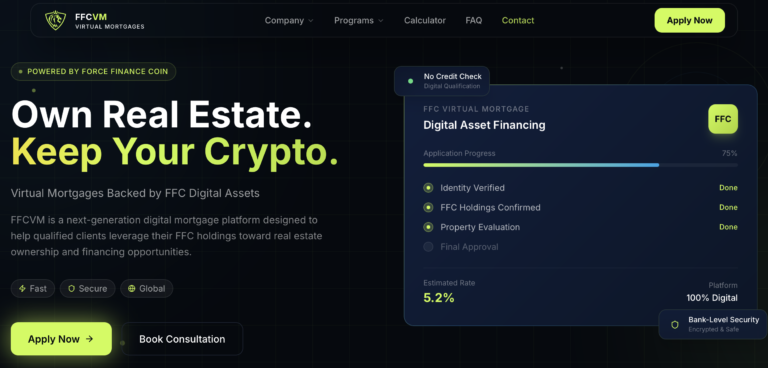
Is Force Finance Coin Virtual Mortgages Legitimate?
Our assessment is that FFCVM.com presents significant questions that prospective borrowers should resolve before sending money, cryptocurrency, personal documents or property information. We could not independently establish from the public evidence reviewed that FFCVM.com is operated by a properly licensed mortgage brokerage or lender authorized to provide the mortgage services it appears to promote.
There is also a documented connection between Force Finance Coin Inc. and Jonathan Marquis. A Canadian corporate directory identifies Force Finance Coin Inc. as an active Canadian corporation incorporated in February 2024 and lists Jonathan Marquis as its sole director.
That is an important finding, but it should not be confused with proof that every allegation made about the business or its associated websites is true.
The original report submitted to Brokers Litmus alleges that Force Finance Coin Virtual Mortgage forms part of what the complainant describes as a broader cryptocurrency operation and identifies Jonathan Marquis as the person behind it.
We have treated that allegation as a report from a complainant, not as an established fact.
What makes this case particularly interesting is the business model itself.
A mortgage secured by real estate is a regulated financial product. Adding cryptocurrency to the funding structure does not remove the need for ordinary mortgage documentation, licensing, underwriting, property security and financial compliance.
That is where our investigation becomes important.
What Is Force Finance Coin Virtual Mortgages?
The name suggests a mortgage service connected to Force Finance Coin, or FFC.
Public information associated with Force Finance Coin describes FFC as a cryptocurrency and DeFi project. Its published whitepaper presents the token as a blockchain based financial ecosystem.
There is also a separate public business connection worth examining.
Jona Enterprises Holdings says it is a majority shareholder of Force Finance Coin and describes Force Finance as expanding from car financing into mortgage financing in Canada. The same page describes FFC as being incorporated into those financial services.
That means the idea of using the Force Finance Coin ecosystem in connection with mortgage financing is not merely something appearing in the complaint. There are public statements from an associated business describing mortgage finance as part of the project’s intended expansion.
The question is therefore not whether the concept exists online.
It does.
The more important question is whether the specific mortgage service offered through FFCVM.com is properly established, licensed and capable of providing the financing it advertises.
A Cryptocurrency Mortgage Is Not Automatically a Scam
There is an important distinction to make here.
Using cryptocurrency in connection with a mortgage does not automatically make a mortgage fraudulent.
Digital assets can potentially be used in legitimate financial arrangements.
A borrower could, for example, hold cryptocurrency as part of their assets, liquidate it for a down payment, or potentially use digital assets as part of a secured financing structure where the relevant lender is willing and legally able to do so.
The unusual part isn’t necessarily the cryptocurrency.
The unusual part is who is providing the mortgage, under what legal structure, and under whose regulatory authority.
That is where prospective borrowers need to do their homework.
The Mortgage Licensing Question
This is one of the biggest issues we encountered.
Canadian mortgage regulation is not simply a matter of registering a company name.
Mortgage brokers are generally regulated at the provincial or territorial level.
The Financial Consumer Agency of Canada explains that provinces and territories regulate mortgage brokers and recommends confirming that a broker is licensed before proceeding.
Alberta provides a particularly useful example.
The Real Estate Council of Alberta states that anyone who deals in mortgages on behalf of another person for compensation, or represents themselves as a mortgage broker, generally requires a mortgage broker licence unless an exemption applies.
RECA’s definition covers activities such as soliciting borrowers or lenders, negotiating mortgage transactions and administering mortgages.
That means a website offering mortgage services should not be assessed only by looking at its cryptocurrency credentials.
You also need to identify the mortgage entity.
Who Is Actually Lending the Money?
This may be the single most important question for anyone considering FFCVM.com.
Ask:
Who is the lender?
Not the website. Not the brand. Not the person communicating with you. The actual legal entity providing the loan.
Then ask:
Where is that lender incorporated?
What regulator oversees it?
What licence does it hold?
Where is the mortgage registered?
What lawyer or title company handles the closing?
What entity receives your payments?
What entity holds the security over the property?
These questions are normal in mortgage finance. A legitimate lender should be able to answer them.
Force Finance Coin Inc. Is a Real Corporate Entity
One thing that should not be overlooked is that Force Finance Coin Inc. does appear in Canadian corporate records.
A publicly accessible corporate directory identifies the company as Force Finance Coin Inc., corporation number 15800595, and reports an incorporation date of February 22, 2024. The record identifies Jonathan Marquis as the director.
The same record reports the company’s registered address in Ottawa and currently shows the corporation as active, although it also reports that its 2026 annual filing was overdue at the time of the directory’s February 2026 update.
This is useful information, but corporate registration should not be confused with financial authorization.
A company can exist legally without being licensed to provide every financial service it advertises.
That distinction is especially important for mortgage businesses.
Corporate Registration Does Not Equal Mortgage Licensing
This is an area where online financial investigations often go wrong.
Someone searches a company’s name.
They find a corporation.
The corporation exists.
They conclude:
“Therefore, the company is legitimate.”
That conclusion is too broad.
Corporate registration establishes the existence of a legal entity.
It does not automatically establish that the entity is authorized to conduct regulated financial activities.
RECA, for example, maintains a dedicated licensing system through which consumers can check mortgage professionals and brokerages. Its ProCheck service allows users to verify whether an individual or brokerage is legally authorized to work in Alberta and to view licence information and disciplinary decisions.
That is the kind of verification prospective borrowers should be looking for.
The Crypto Side Creates Another Layer of Due Diligence
A mortgage lender dealing with cryptocurrency potentially has additional compliance considerations.
FINTRAC states that mortgage administrators, mortgage brokers and mortgage lenders can have obligations under Canada’s anti money laundering and anti terrorist financing legislation.
Those obligations include transaction reporting, record keeping and other compliance requirements.
The Canadian government also notes that mortgage administrators, brokers and lenders became subject to AML and ATF controls under the federal framework effective October 11, 2024.
This is particularly relevant when cryptocurrency is part of the transaction.
A borrower should expect legitimate financial professionals to care about the source of funds, identity verification and documentation.
If someone tells you that these ordinary checks are unnecessary because the transaction is “crypto based,” that should make you stop.
The Source of Funds Should Be Clear
Suppose a borrower wants to purchase a $500,000 property. They have $150,000 worth of Bitcoin. A legitimate financial institution considering that wealth would reasonably want to understand the source and history of the assets. The borrower may need to document: Where the cryptocurrency was purchased Which exchange was used How long the assets were held How the assets were acquired How the cryptocurrency was converted into fiat Where the resulting funds were deposited Who ultimately owns the money That isn’t an unreasonable obstacle. It is part of financial due diligence. FINTRAC specifically identifies record keeping, client identification and reporting requirements within the mortgage sector.
Be Careful With the Word “Virtual”
The name Force Finance Coin Virtual Mortgages is itself worth examining carefully. “Virtual mortgage” isn’t a substitute for describing the actual financial product. A borrower should be able to determine whether they are receiving: A conventional mortgage A private mortgage A crypto collateralized loan A mortgage funded by a private investor A loan denominated in cryptocurrency A fiat mortgage where cryptocurrency is simply the source of funds Or something else entirely Those structures have very different legal and financial implications. A professional mortgage provider should be able to explain the product in plain language. If the explanation relies primarily on cryptocurrency terminology rather than a conventional loan agreement, that’s a reason to slow down.
What Happens to the Property?
This is one of the questions we would ask before signing anything.
A genuine mortgage is secured against property.
So where is the security?
If someone offers you a mortgage to purchase a home, ask:
Who will be registered on title?
What mortgage charge will be registered?
Which legal entity is the mortgagee?
Who prepares the closing documents?
Which lawyer represents the lender?
Who receives the mortgage payments?
What happens if the borrower defaults?
A legitimate mortgage transaction has answers to these questions.
A cryptocurrency wallet address does not substitute for them.
The Blockchain Does Not Replace Property Law
This is an important misconception.
Blockchain technology can record transactions.
It can facilitate payments.
It can provide transparent transaction histories.
But a blockchain token does not automatically create a valid mortgage charge against real property.
Real estate ownership and mortgage security are governed by the laws and land registration systems of the jurisdiction where the property is located.
That is why the legal paperwork surrounding a mortgage matters just as much as the technology used to move the money.
Public Claims About FFC Deserve Scrutiny
There are some unusually ambitious claims associated with Force Finance Coin.
A published FFC whitepaper presents the project as a blockchain based financial ecosystem intended to provide a range of financial functions.
Another associated business publicly states that Force Finance Coin was initially focused on car finance and was expected to expand into mortgage financing in Canada. It also describes FFC as a major asset within that business strategy.
These claims create a straightforward due diligence question:
Can the financial infrastructure supporting those claims be independently verified?
That means looking beyond promotional language.
The Token’s Public Data Raises Separate Questions
There is also an important point concerning the FFC token itself.
ICOholder lists Force Finance Coin with a stated total supply of 5 billion tokens and identifies Jonathan Marquis as CEO and founder, while noting that its listed team members were unverified.
A separate token tracking source currently flags a Force Finance Coin token on Solana as unverified and reports extremely concentrated ownership and low liquidity for that particular token.
That information needs to be interpreted carefully.
There can be multiple tokens using the same name or ticker.
The Solana token flagged by Solflare should not automatically be assumed to be the same asset described in the project’s earlier Ethereum materials.
In fact, that inconsistency is itself a reason for caution.
Before purchasing any FFC token, investors should verify the exact blockchain, contract address and issuing entity.
A ticker symbol alone is not enough.
Multiple Versions of a Token Can Create Confusion
This is a particularly useful lesson for readers.
Crypto investors sometimes search for a token by name.
They see:
FFC
They assume they have found the correct asset.
But blockchain ecosystems can contain unrelated tokens with identical or similar names and symbols.
Solflare explicitly warns that multiple tokens can use the same name and symbol and identifies the token it reviewed as unverified.
That makes contract verification essential.
If a mortgage provider tells you to purchase a particular cryptocurrency, don’t simply search the ticker.
Ask for the exact contract address.
Then verify it independently.
A Mortgage Should Not Depend on Blind Trust
One of the biggest differences between a conventional mortgage and a questionable online financial proposition is the ability to verify the transaction independently.
With a conventional mortgage, borrowers can usually identify:
The lender
The mortgage broker
The lawyer
The property
The interest rate
The term
The repayment schedule
The security registered against the property
The closing documents
The applicable regulator
A borrower considering a crypto based mortgage should expect the same level of transparency.
Cryptocurrency technology should not make the basic structure of a mortgage less understandable.
What We Could Verify About Jonathan Marquis
The name Jonathan Marquis appears in several publicly accessible sources associated with Force Finance Coin.
The Canadian corporate record identifies Jonathan Marquis as director of Force Finance Coin Inc.
ICOholder separately identifies Jonathan Marquis as CEO and founder of Force Finance Coin, although it marks the team listing as unverified.
The company’s broader public ecosystem also associates Force Finance with financial services and mortgage expansion.
These connections are useful because they establish that the name is not merely something appearing in the complainant’s allegation.
At the same time, an association with a company does not establish that every website, person or transaction using that company’s name is authorized.
That is why the exact relationship between FFCVM.com and the underlying corporate entity needs to be documented.
What Would Make Us More Comfortable With FFCVM.com?
There are several straightforward things that could make the service easier for prospective borrowers to evaluate.
First, a clearly identified legal lender.
Second, a verifiable mortgage brokerage or lender licence where required.
Third, clear disclosure of the jurisdiction in which the mortgage is issued.
Fourth, a conventional mortgage agreement identifying the lender and borrower.
Fifth, clear information about interest, fees and repayment.
Sixth, independent legal closing arrangements.
Seventh, a transparent explanation of how cryptocurrency enters the transaction.
Eighth, independently verifiable property security.
These aren’t unreasonable demands.
They’re basic due diligence.
What Should Make a Borrower Stop?
There are also circumstances where we would recommend stopping the transaction until independent verification has been completed.
Be especially cautious if someone asks you to:
Send cryptocurrency to a personal wallet
Pay an “activation” fee before receiving a mortgage
Buy a particular token as a condition of loan approval
Pay additional cryptocurrency to release loan proceeds
Send money to an individual rather than the disclosed lender
Transfer funds before receiving formal loan documentation
Provide your wallet seed phrase or private key
Use cryptocurrency to bypass ordinary mortgage documentation
Any one of these deserves scrutiny.
Several occurring together would be considerably more concerning.
Don’t Send a Wallet Seed Phrase to a Mortgage Provider
This deserves emphasis because cryptocurrency introduces a type of risk that traditional mortgage borrowers don’t normally encounter.
A mortgage provider does not need your cryptocurrency wallet recovery phrase.
They don’t need your private key.
They don’t need unrestricted control over your wallet.
If somebody asks for a seed phrase, stop immediately.
A legitimate financial transaction can be structured without handing over the credentials that control your digital assets.
How to Verify a Mortgage Provider
If FFCVM.com or any other online mortgage provider approaches you, start with the regulator rather than the company’s own website.
In Alberta, consumers can use RECA ProCheck to verify mortgage professionals and brokerages.
For other provinces, the applicable provincial regulator should be checked.
The Financial Consumer Agency of Canada maintains guidance explaining that mortgage brokers are regulated provincially and territorially and recommends confirming licensing before proceeding.
You should also independently verify the corporate entity.
Then verify the lender.
Then verify the property security.
Only after those pieces line up should you consider transferring money.
Our Assessment of Force Finance Coin Virtual Mortgages
The evidence available for this review does not justify presenting the allegation that Jonathan Marquis “runs a crypto scam” as an established fact.
What we can establish is more nuanced.
Force Finance Coin Inc. appears in Canadian corporate records, with Jonathan Marquis identified as its director.
Public material associated with Force Finance describes financial applications for FFC and an expansion into mortgage financing in Canada.
There is also a public FFC whitepaper describing a blockchain based financial ecosystem.
However, our review did not independently establish from the sources examined that FFCVM.com is a properly licensed mortgage brokerage or lender authorized to offer its claimed mortgage services in every jurisdiction in which it may solicit customers.
That is the critical gap.
For something as significant as a mortgage, a borrower shouldn’t have to guess who the lender is or which regulator oversees the transaction.
Is FFCVM.com a Scam?
We would not state as a fact that FFCVM.com is a scam based solely on the supplied report.
However, we would classify the opportunity as high risk and requiring substantial independent verification before any money or cryptocurrency is transferred.
The combination of a cryptocurrency based financial ecosystem, mortgage claims, the reported connection to Force Finance Coin, and the limited independent evidence we could verify about the specific mortgage operation creates enough uncertainty that prospective borrowers should proceed very carefully.
The strongest concern isn’t simply that cryptocurrency is involved.
It’s whether the mortgage itself can be independently verified through the ordinary legal and regulatory framework governing mortgages.
That is the test we would apply.
Final Verdict
Force Finance Coin Virtual Mortgages and FFCVM.com require significant due diligence before anyone should treat them as a conventional mortgage provider.
There is evidence of a real corporate entity associated with Force Finance Coin and a publicly described intention to expand into mortgage finance.
But corporate existence is not the same as mortgage authorization.
The supplied allegation should therefore remain identified as an allegation unless stronger evidence becomes available.
For anyone considering a mortgage through FFCVM.com, the most important questions are simple:
Who is the legal lender?
What regulator licenses the mortgage activity?
Where is the mortgage registered?
Who handles the legal closing?
Where will your money or cryptocurrency actually go?
What happens if you don’t buy the associated token?
Can every answer be independently verified?
If those questions cannot be answered clearly, don’t let the promise of cryptocurrency based financing push you into transferring money.
A mortgage is one of the largest financial commitments most people will ever make.
Innovative technology may change how financing is delivered.
It should never eliminate the paper trail, regulatory oversight and legal protections that allow a borrower to understand exactly what they are signing.
Useful Verification Resources
RECA ProCheck: Verify Alberta mortgage professionals and brokerages. RECA ProCheck
Financial Consumer Agency of Canada: Mortgage preapproval and broker guidance. Canada.ca mortgage guidance
FINTRAC: Mortgage administrators, brokers and lenders and their compliance obligations. FINTRAC mortgage requirements
RECA mortgage licensing requirements: Understand when mortgage licensing is required in Alberta. RECA mortgage licensing information
Force Finance Coin whitepaper: Publicly available project documentation. Force Finance Coin whitepaper
Force Finance Coin corporate information: Public corporate record identifying Force Finance Coin Inc. and Jonathan Marquis. Force Finance Coin corporate record